
OEM Jewelry Manufacturing: What a Tech Pack Must Contain
A tech pack is the difference between a quote and a guess. The intake for an OEM/ODM brief accepts rough hand drawings, reference photographs or a full pack, but every field you leave blank comes back as a question — and questions are the only thing that stretches the published clocks of sampling at from CAD at 48 hours through sampling at 25–30 days to production at 3–4 weeks (run) — CAD, sample, run (run) in production for production.
Key takeaways
- Six fields drive everything downstream: base material, plating and finish, chains and findings, stones and accents, logo and hallmark, packaging.
- CAD comes back inside 48 hours for dimensional approval, so the pack only needs to be dimensionally complete, not beautiful.
- Sampling takes 25–30 days and production 3–4 weeks, both unchanged by how polished your artwork looks.
- Leaving the base material blank is the most expensive omission, because it sets the minimum order and the tooling route.
The six fields that cannot be left blank
Colour from gold in 14K, 18K and 24K and rhodium; protection from a protective anti-tarnish e-coat on silver and brass and PVD on stainless steel.
Chains and findings decide how the piece hangs and closes. Stones and accents cover natural stones and freshwater pearls. Logo and hallmark covers laser engraving and the 18KGP on gold-plated work, the S925 hallmark and 316L on stainless mark. Packaging closes the loop with the five published lines from metallic logo tags through to barcode labelling.
What a tech pack does not need to contain
It does not need production drawings. The CAD stage exists to turn your brief into a dimensioned drawing and realistic renderings, and the workshop does that work inside 48 hours. Nor does it need a finished colour rendering or a packaging mock-up — a sentence describing the direction is enough for a first quote.
This is the part buyers overthink. A pack with six fields answered in plain words beats a beautiful document with the base material left ambiguous, because the ambiguous version comes back as an email and the email costs a day.
The three published windows, and where a pack fits
Only three timings are published, and none of them bends because a brief is more or less detailed. What detail changes is when the clock starts.
| Field in the pack | Published figure it affects | If it is missing |
|---|---|---|
| Base material | 50 / 100 / 100+ pcs per design | No minimum can be quoted |
| Plating and finish | 14K, 18K, 24K gold, rhodium, e-coating, PVD | Cost per piece stays open |
| Stones and accents | Stone setting inside the sample window | Setting time cannot be planned |
| Logo and hallmark | Laser engraving, S925 / 316L / 18KGP | Tooling is cut without the mark |
Notice what is absent from that table: nothing about pack length, page count or software format. The intake is content-driven, and a photographed sketch with the six fields written on the back is a complete pack.
Worked example: 25–30 days and 3–4 weeks in one unit
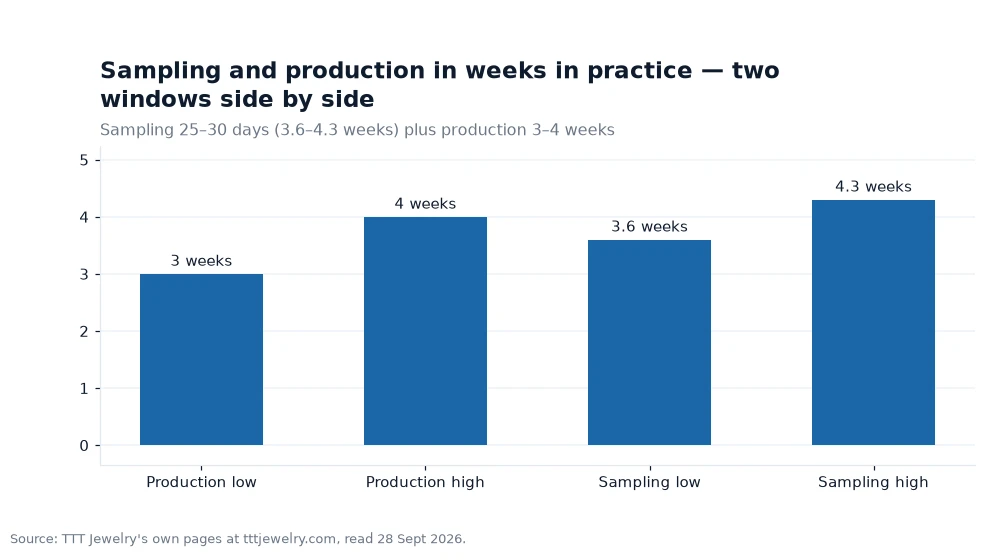
Sampling at the inner edge of the published window is 25 days, and 25 ÷ 7 = 3.57 weeks, which rounds to 3.6. At the outer edge it is 30 ÷ 7 = 4.29, or 4.3 weeks. Production is 3 weeks at the floor and 4 at the ceiling, which are already whole numbers.
Put the fastest combination together: 25 days of sampling plus 21 days of production is 46 days, and 46 ÷ 7 = 6.6 weeks. Slowest: 30 + 28 = 58 days, and 58 ÷ 7 = 8.3 weeks. Four of those weeks are yours to lose on approvals. The divisions are my arithmetic; 25–30 days and 3–4 weeks are published.
How the pack decides your minimum order
The base material field is the one that changes the invoice size. A 925 silver, stainless steel and artisan brass with recycled content at 100+. Put the wrong material in the pack and you may find the design you wanted at 50 pieces is only quoted at 100 because the metal you named cannot be cast the way you imagined.
That is why the consultation stage exists: feasibility, material selection and cost structure get settled before drawing, and a five-minute conversation at that point is cheaper than a sample built on the wrong base.
Where the pack meets the minimum order
Two fields interact in a way that surprises first-time buyers: the metal you name and the quantity you plan. Silver casting is the lightest route per piece, so 50 pieces per design is enough to tool a design in 925 silver, artisan brass with recycled content and stainless steel starts at 100+ because machining and PVD finishing cost more to set up.
So a pack that says "silver, about 60 pieces" is answerable, while a pack that says "silver, about 20 pieces" has to come back with a question about whether the design could be reworked for a plated base. Putting an approximate quantity in the first message costs nothing and removes a whole round trip.
What usually goes wrong with an incomplete pack
Three patterns repeat. A design sent as a photograph with no scale, which forces the drawing team to guess a diameter. A stone list without sizes, which pushes the setting decision into the sample. A packaging request mentioned at the last minute, when the barcode labels and backing cards needed to be decided alongside the artwork.
Each of those adds a round trip. None of them extends a published window; they delay when it starts. Which fields the factory actually reads is spelled out by the OEM ODM jewelry manufacturer, and the 925 silver route The brass range reads from the same list. applies the same list to one alloy.
Frequently asked questions
Will a rough sketch be accepted instead of a pack?
Yes. Hand drawings, reference images and written concepts are all accepted inputs, and the design team converts any of them into a dimensioned CAD drawing inside 48 hours.
Should the pack name the base material before the quote?
Minimums run 50 in sterling silver, 100 plus in the stainless line and 100 pcs in the eco-brass line, by design, with each design counted separately.
Does the pack need packaging details at the first enquiry?
A single sentence is enough to start. Gift boxes, pouches, backing cards, logo tags and barcode labelling are decided in detail while the sample is being built.
Submitting a pack that gets a useful answer
Send the six fields in the body of the message rather than as an attachment, and put the expected piece count next to the material. That one line — "brass, 18K gold plating, 300 pieces, one design" — is enough for a supplier to answer with a tooling route, a minimum and a schedule instead of a request for more information.
If a first run is likely to move between metals, the two entries worth reading side by side are the 925 silver manufacturing route and the brass jewelry route, because their finishing steps differ even though their sampling window does not.
What this article works from — the 24-hour reply commitment as well as the master sample rule, followed by the 3–4 week production run — is written up at the manufacturer's own site through tttjewelry.com, as of 28 Sept 2026. The quality-system standard, ISO 9001:2015, is listed there as well. The side-by-side reading is mine alone, and nothing else here [1]