
A supplier can present an impressive capability story at every stage of a project, but the handover from approved sample to bulk order is where the story is either supported by records or quietly contradicted. That single transition shows how a factory keeps a reference, how it handles material variation, how it documents a batch and how it responds when something differs. For a direct-to-consumer brand choosing a private label partner, it is the cheapest and most informative capability test available.
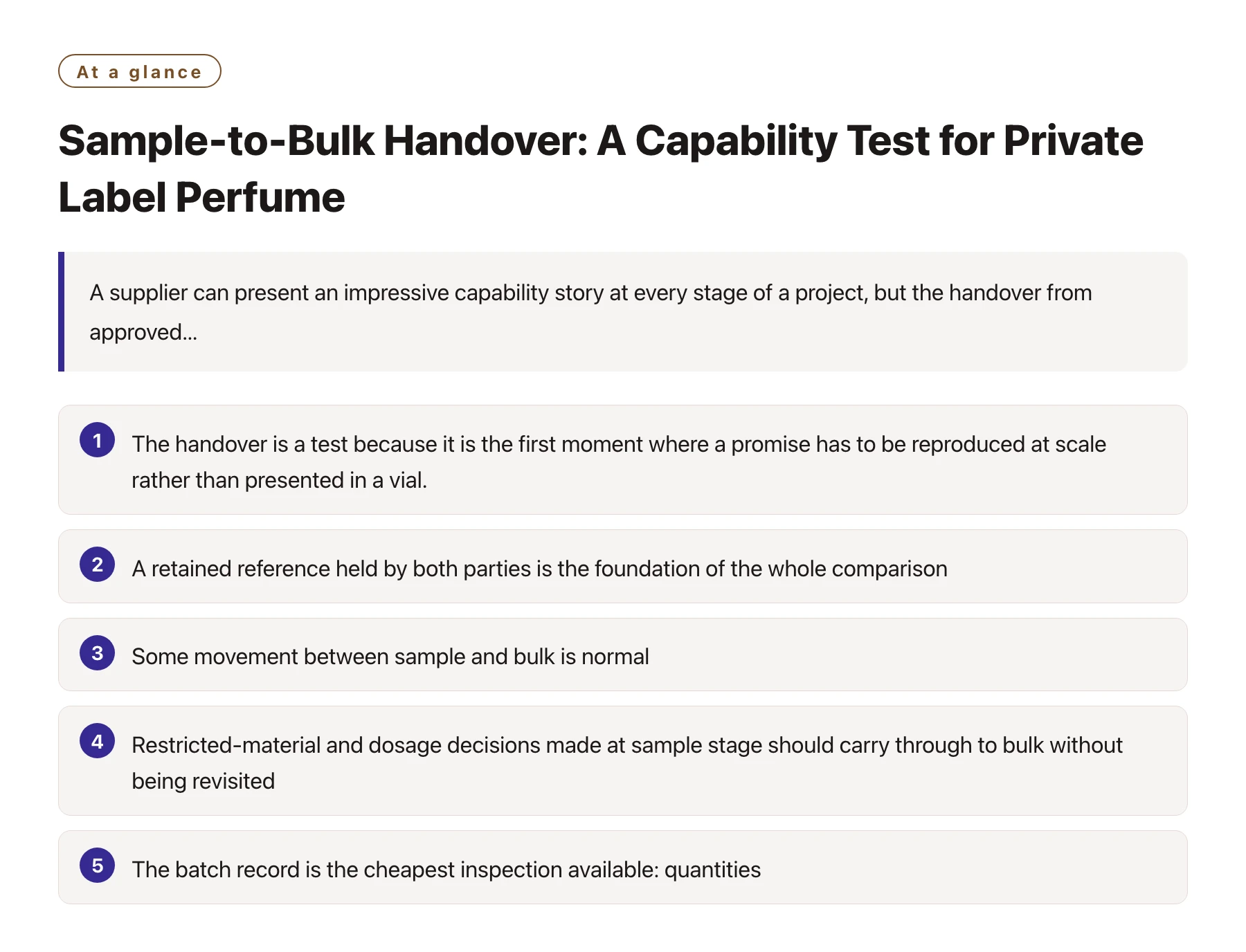
Key takeawaysThe handover is a test because it is the first moment where a promise has to be reproduced at scale rather than presented in a vial. · A retained reference held by both parties is the foundation of the whole comparison, and if it does not exist at handover the conversation has no anchor [2]. · Some movement between sample and bulk is normal, because material lots and maceration time differ; the question is whether the difference was anticipated and documented. · Restricted-material and dosage decisions made at sample stage should carry through to bulk without being revisited, and category-specific limits should already be settled [1]. · The batch record is the cheapest inspection available: quantities, lot numbers, fill weights and any deviation note tell a buyer more than a tour of the site. · A factory that flags a small difference before the buyer notices it is demonstrating exactly the behaviour a repeat order depends on [3].
Private label fragrance buyers tend to audit in the wrong place. They audit the showroom, the certificate folder or the factory floor, and they get a curated view in each. The handover from approved sample to bulk production cannot be curated in the same way, because it is a comparison between two physical objects that the buyer can smell and test independently.
This is not about catching a factory out. Genuine variation exists: a different lot of a raw material, a longer or shorter maceration period, a filling line that runs at a different speed. What the handover reveals is whether the factory knows its own variation, measures it, and tells the buyer before the pallet ships.
The list below is written for a buyer running a first or second private label order with a manufacturer, and it assumes the brand has a reference unit and a written specification on file.
Set the comparison up before the bulk lands
The handover can only be evaluated if two things exist before production starts. The first is a sealed reference from the approved sample, labelled with the approval date and held under agreed conditions by both parties. The second is a specification that states the concentration, the fill volume, the bottle and pump combination and the acceptable tolerances.
Buyers who skip this step find themselves comparing a bulk batch against a memory, which is the least reliable instrument in the building. The reference does not need to be elaborate, and it does not need to be permanent; it needs to be identifiable, stored sensibly and replaced on a defined cycle so that it does not drift into irrelevance.
It is also worth agreeing in advance how the comparison will be made: which units, at what dilution or in what format, in what kind of room, and who signs the result. A short method agreed at the start removes most of the ambiguity from the conversation that follows.
What to inspect during the handover, and what it predicts
| Capability check | How it shows up at handover | What it predicts about the next order |
|---|---|---|
| Reference discipline | A labelled retained reference is produced immediately when asked for, dated and stored as agreed | Repeat orders can be compared against a fixed point rather than against memory |
| Material traceability | The batch record names the lots used and any substitution, with a note explaining it | A future material change is likely to be disclosed rather than discovered |
| Consistency of the compound | A freshly opened bulk sample reads close to the reference after the agreed resting period | The scent on the third order will resemble the scent on the first |
| Fill and function | Units from the actual run, not the pilot, are tested for fill weight, spray and leakage | Packing line settings are controlled rather than assumed |
| Documentation timing | Batch record, certificate of analysis and test summaries arrive without being chased | Compliance requests at shipment will not turn into a delay |
| Deviation handling | Small differences are flagged by the factory before the buyer raises them | Problems will surface while they are still cheap to fix |
| Sample-to-bulk communication | A named technical contact answers comparison questions with specifics rather than reassurances | The relationship has an actual technical interface, not a sales one |
Seven checks, none of which requires a laboratory or a plant visit. What they have in common is that each one is about behaviour under a small amount of pressure, which is precisely what a supplier's presentation cannot simulate. Buyers who want to see how these checks look in a real programme can compare them against published examples of fragrance projects, and it is worth reading any account of a handover for what it says about deviations rather than about the finished product.
The difference between variation and drift
Buyers often treat any difference between sample and bulk as a defect, which is both unfair and counterproductive. Variation is normal and bounded: a fresh lot of a natural material, a slightly longer maceration, a warmer week in the warehouse. Drift is different. Drift is a direction, a formula or a process moving away from the approved reference over successive orders without anyone deciding that it should. Buyers who want to understand the mechanics behind that distinction, and the handful of causes that account for most of it, can work through why a sample and the bulk order can differ before the first bulk release rather than after it.
The practical way to tell them apart is to compare against two references rather than one: the original approved unit and the most recent released batch. A single-step difference against the original that disappears when compared with the last release is variation. A sequence of small differences that all point the same way is drift, and it is worth raising early because it compounds.
This is where a trained reviewer earns their place. Describing drift requires vocabulary and consistency of method, because the observation is about a trend rather than a single sample. A team able to say that the base has become progressively thinner across three orders is making a claim the factory can act on, while a team reporting that something feels off is not.
Reading the batch record like a buyer
The batch record is a document produced for internal purposes, which is exactly what makes it useful. The quantities actually weighed, the lot numbers drawn, the fill weights recorded during the run and the deviation notes together describe what happened rather than what was planned. A record with a handled deviation is reassuring, because it shows the system working. A record with no deviations at all, on a run where the buyer can smell a difference, is a more interesting document [3].
Test data should be read alongside it and checked for relevance: a stability summary for the same formula version and the same package combination is applicable, while one produced before a change is not [2].
Turning the handover into a repeatable process
The handover becomes easier every time it is run in the same way. A one-page handover checklist, with the same checks in the same order, produces a comparable record for every order, which turns a series of individual judgements into a trend the brand can see. It also shortens each round, because the questions are the same and the answers arrive in the same shape.
For a brand planning a range, that comparability is worth more than the time it takes to build. It means the second product can be judged on the same basis as the first, and a difference between two products is visible as a difference rather than as an impression.
If a buyer takes one thing from the handover, it should be the factory's reaction to a question about a small difference. A partner that produces the retained reference, walks through the batch record and volunteers the relevant test summary is demonstrating the behaviour that makes a long relationship workable. A partner that answers with reassurance is revealing something different. This is also why the handover is a better capability test than a site visit for a first order: it costs nothing extra, it happens anyway, and it cannot be staged. Brands comparing manufacturers should ask how each one runs the sample-to-bulk handover before they ask about price, because the answer describes the operating system behind every quotation. When a brand is looking for best private label perfume factory candidates, contrasting that answer across two or three suppliers is usually enough to make the choice, and it is the reason programmes built on white label fragrance manufacturing tend to be judged on the handover rather than on the brochure.
Sources
- IFRA Standards Library (International Fragrance Association) —— The IFRA Standards Library lists the restrictions the fragrance industry applies to individual fragrance ingredients, based on safety assessments; it is the reference point for compliant fragrance formulation.
- SGS: Cosmetics, Personal Care & Household Testing —— Testing, inspection and certification services for cosmetics and personal care, including microbiological, stability and safety testing aligned with cosmetics GMP.
- Cosmetics & Toiletries —— A technical magazine for cosmetic formulators, covering ingredients, formulation science and testing methods.
Frequently asked questions
Why does a bulk order smell different from the approved sample?
The usual causes are different raw material lots, a different maceration or resting period, and the larger volume of a bulk batch developing marginally differently. Some movement is expected. What matters is that the factory measured it, documented it and disclosed it rather than leaving the buyer to notice.
What is a retained reference sample and why does it matter?
It is a sealed unit from the approved sample, labelled with the approval date and stored under agreed conditions by both parties. It gives every later comparison a fixed point, so judgements about bulk quality do not depend on anyone's memory of a smell from three months earlier.
Should we reject a bulk batch that differs slightly from the sample?
Only if it falls outside the tolerances in the specification. A difference inside the agreed range is variation and is normally recorded. A difference outside it is a contractual matter, and having the specification and reference in place is what makes the conversation factual.
Do we need to visit the factory for the handover?
For a first order it is rarely necessary. A freshly opened bulk sample sent by courier, the batch record, the test summaries and photographs of the filled units cover the checks described here. A visit is most valuable before the first order and for very large runs where the cost of a problem justifies being present.
How often should the retained reference be replaced?
On a defined cycle rather than when it becomes obviously different. Keeping the original reference plus the most recent released batch is the most practical arrangement, because it allows single-step variation to be distinguished from a slow trend across several orders.